
Day 32
As though they were on dry land

To Start
Empty your mind. Put down your worries, logistics, even your curiosities. Meet God in the emptiness. Let it be filled with Him (by Him).
Pray
Yahweh, as You uncovered the sea and revealed its bottom, show me what’s covered, reveal to me the heart of Your Word & reveal to me my own heart.
Read
Read Hebrews 11:29 & Exodus 14:10-31.
Describe Israel as they face the Egyptian army on one side and the Red Sea on the other. What was the state of their hearts?
Try to imagine the scale and wonder of this miracle. Put yourself inside the moment and look around.
Meditate on the phrase “as though they were on dry land.”
What’s the difference between Israel’s crossing of the sea and Egypt’s? Why is one successful and the other a failure?
Consider the first words of verse 29: “By faith they.” This is our first “they” in the Hebrews 11 list—we’ve only had individuals so far. How does a group cultivate collective faith? How does Yahweh measure group faith?
Hebrews 11:29 (CSB)
By faith they crossed the Red Sea as though they were on dry land. When the Egyptians attempted to do this, they were drowned.
Exodus 14:10-31
10 As Pharaoh approached, the Israelites looked up and there were the Egyptians coming after them! The Israelites were terrified and cried out to the Lord for help. 11 They said to Moses, “Is it because there are no graves in Egypt that you have taken us away to die in the wilderness? What have you done to us by bringing us out of Egypt? 12 Isn’t this what we told you in Egypt: Leave us alone so that we may serve the Egyptians? It would have been better for us to serve the Egyptians than to die in the wilderness.”
13 But Moses said to the people, “Don’t be afraid. Stand firm and see the Lord’s salvation that he will accomplish for you today; for the Egyptians you see today, you will never see again. 14 The Lord will fight for you, and you must be quiet.”
15 The Lord said to Moses, “Why are you crying out to me? Tell the Israelites to break camp. 16 As for you, lift up your staff, stretch out your hand over the sea, and divide it so that the Israelites can go through the sea on dry ground. 17 As for me, I am going to harden the hearts of the Egyptians so that they will go in after them, and I will receive glory by means of Pharaoh, all his army, and his chariots and horsemen. 18 The Egyptians will know that I am the Lord when I receive glory through Pharaoh, his chariots, and his horsemen.”
19 Then the angel of God, who was going in front of the Israelite forces, moved and went behind them. The pillar of cloud moved from in front of them and stood behind them. 20 It came between the Egyptian and Israelite forces. There was cloud and darkness, it lit up the night, and neither group came near the other all night long.
21 Then Moses stretched out his hand over the sea. The Lord drove the sea back with a powerful east wind all that night and turned the sea into dry land. So the waters were divided, 22 and the Israelites went through the sea on dry ground, with the waters like a wall to them on their right and their left.
23 The Egyptians set out in pursuit—all Pharaoh’s horses, his chariots, and his horsemen—and went into the sea after them. 24 During the morning watch, the Lord looked down at the Egyptian forces from the pillar of fire and cloud, and threw the Egyptian forces into confusion. 25 He caused their chariot wheels to swerve and made them drive with difficulty. “Let’s get away from Israel,” the Egyptians said, “because the Lord is fighting for them against Egypt!”
26 Then the Lord said to Moses, “Stretch out your hand over the sea so that the water may come back on the Egyptians, on their chariots and horsemen.” 27 So Moses stretched out his hand over the sea, and at daybreak the sea returned to its normal depth. While the Egyptians were trying to escape from it, the Lord threw them into the sea. 28 The water came back and covered the chariots and horsemen, plus the entire army of Pharaoh that had gone after them into the sea. Not even one of them survived.
29 But the Israelites had walked through the sea on dry ground, with the waters like a wall to them on their right and their left. 30 That day the Lord saved Israel from the power of the Egyptians, and Israel saw the Egyptians dead on the seashore. 31 When Israel saw the great power that the Lord used against the Egyptians, the people feared the Lord and believed in him and in his servant Moses.
From JL
My first thought upon reading today’s installment of Hebrews 11 was, “Wow. God is so generous.” Just like Sarah who laughed and Moses who was afraid, Israel isn’t exactly known for handling this Red Sea moment with unwavering courage. But God called it faith anyway.
What did Israel do by faith? They crossed.
They started walking and they kept walking.
It may not seem like a lot, but it really is something.
A few things to note about this moment:
It is unlikely the Israelites had ever seen a body of water larger than the Nile River. The Nile River at its widest point is 1.7 miles across. The Red Sea, on the other hand, has an average width 100 times that. Even if Israel crossed at a narrower spot (they likely did as 170 miles is a bit too much for an overnight walk) they would have been looking at a 7 to 17 mile journey. In other words, Israel could not see the other side when they started walking.
In ancient times, the sea was a symbol of chaos and death. Entering a sea (as a swimmer, on a boat, or in their case, on foot) was surrendering oneself to death.
Surrender to Egypt would have been a guarantee of life (a slave’s life, but still, life).
So when Israel sees God part the sea, they do have a choice to make. It’s not walk or die. It’s walk (and perhaps die in the massive sea) or surrender to Egypt (and live as a slave, the same as they have every day of their lives so far).
Israel has to choose between the life they’ve seen with their eyes and the life they’ve only dreamt of. They have to choose between the power they’ve witnessed (pharaoh’s) and the power they’re witnessing (Yahweh’s). They have to choose the hope of salvation over the guarantee of another day.
When my daughter was a baby she was always trying to jump out of my arms. She hated being carried because she loved crawling around exploring. Again and again I’d pick her up to protect her from some life-threatening danger, and immediately she’d scream and wriggle and do her best to propel herself onto the ground.
Standing in front of the Red Sea, Israel didn’t do that. They considered it. But they didn’t do it.
By faith, they let God save them.
Process
We asked above, “How does a group cultivate collective faith?” Do you have experience with this? Have you seen groups grow in faith? Have you seen groups lose faith? Consider the groups you’re in: How does a family live by faith? How does a church live by faith? How does a non-profit live by faith? What about a PTA, a nation, a Home Owner’s Association, a book club…
Pray
Yahweh, am I getting in the way of You saving me? Empower me to walk and keep walking when You split seas.
In the comments
As we think about the idea of collective faith…
Who makes it easy for you to have faith? Which groups/friendships/even systems make your faith flourish?
Godspeed,
JL
For Fun
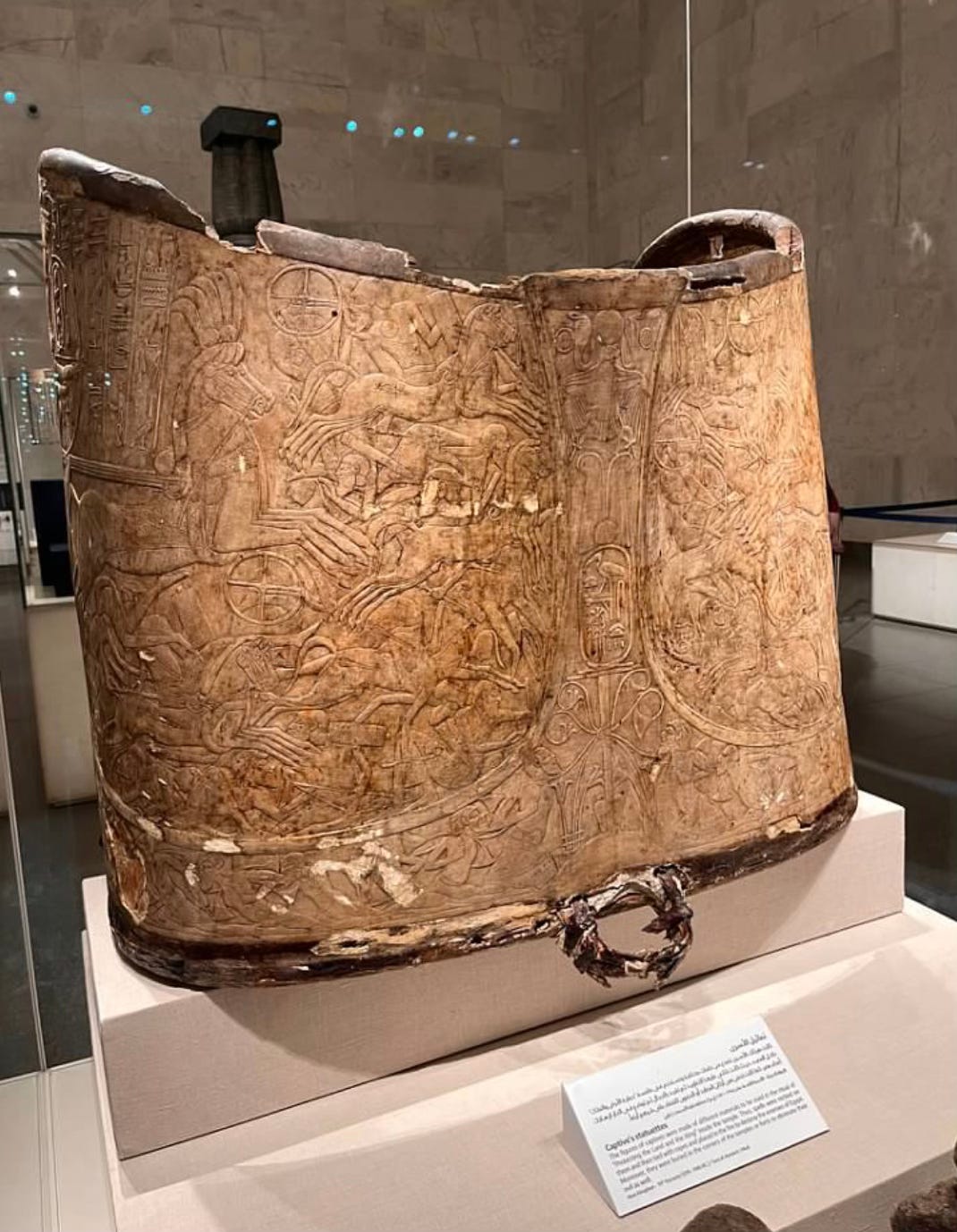
A few pictures from our family’s trip to the Red Sea (including a chariot from the reign of Ramses II, possibly the pharaoh from the Exodus account):


In my first years of ministry in Germany, I belonged to a semi-monastic community, scattered around Germany but gathering regularly to support and encourage one another in our various callings. Our life together centered around a rule of life focused on worship and prayer, witness in everyday life, and service to those in need. Founded at a time when Germany had been shattered by the First World War and the Church had been abandoned by many, the community lived with a conviction that "we can only build the Church if we are the Church ourselves." So, we gathered with Acts 2-like devotion to rekindle faith. As a young man, it was hugely inspiring to gather with older men, some of whom had experienced "Life together" with Dietrich Bonhoeffer. Faith nurtured by what the reformers called the "ordinary means of grace." Fifty years later, I remain committed to this vision of faith being strengthened in community.
I got stuck at these sentences: "It would have been better for us to serve the Egyptians than to die in the wilderness. But Moses said to the people, 'Don’t be afraid. Stand firm and see the Lord’s salvation that he will accomplish for you today'. This would not be the last time the people would look back nostalgically at life in Egypt. I've always laughed at the passage in Numbers 11, when the Israelites, while wandering in the wilderness, complained about God's provision of manna and craved their slaves' diet of cucumbers, melons, leeks and onions. Both at the sea and in the wilderness, Moses names the thing that gets in the way of faith: fear. Think about that. Maybe check out all the later scenes in the New Testament when "Fear not" is the invitation to faith. When I look back over the "hall of faith" in Hebrews 11, in every case there was something to be afraid of.